
Charlotte and Greenville are close enough that they’re often part of the same conversation.
They’re only a couple of hours apart. Both are growing. Both have strong economies, active downtowns, great restaurants, established neighborhoods, and easy access to the Carolinas.
But living in them feels pretty different.
Charlotte gives you the scale, opportunities, and amenities of a major city. Greenville offers many of the things people enjoy about city living, but in a smaller environment with easier access to neighborhoods, outdoor recreation, and surrounding communities.
If you’re considering moving to Greenville, SC from Charlotte, the question isn’t really which city is better.
It’s which one better fits the life you’re looking for.
For anyone relocating to Greenville, SC, that usually means looking beyond home prices and comparing what everyday life actually feels like in both places.
Greenville vs. Charlotte at a Glance
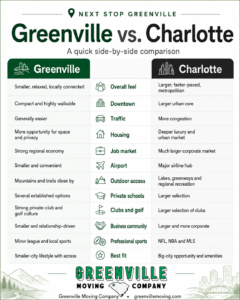
Charlotte feels like a major metro because it is one.
That comes with some real advantages.
There are more employers, more neighborhoods, more flights, more major events, more professional sports, more luxury retail, and a much larger restaurant and entertainment scene.
There’s also more traffic, more development, and simply more city to navigate.
Greenville operates at a much smaller scale.
That doesn’t mean Greenville is just a small downtown surrounded by suburbs. It’s the center of a larger Upstate region that includes communities like Greer, Simpsonville, Travelers Rest, Mauldin, Taylors, and Five Forks.
Still, the scale is different.
One of Greenville’s biggest appeals is that you can enjoy many city amenities without feeling like navigating the city has to become part of your daily strategy. That smaller scale is also a big part of the quality of life in Greenville, SC for people who value convenience, access, and a little more breathing room.
That difference in scale shows up in almost every part of daily life, but housing is one of the clearest places to see it.
Greenville vs. Charlotte Housing and Cost of Living
What Does Your Housing Budget Buy in Greenville vs. Charlotte?
Housing is one of the biggest differences between Charlotte and Greenville.
At the broad market level, Greenville is generally less expensive. As of July 2026, Zillow puts the typical home value in Greenville at about $332,000, compared with about $397,000 in Charlotte — a difference of roughly 16%.
The bigger housing story is this: the typical home costs about $65,000 less in Greenville than in Charlotte.
And if you move beyond central Greenville, that same budget can often stretch even further.
Instead of putting more of your budget into location alone, you may be able to use it for:
- More square footage
- A larger yard
- More separation from neighbors
- Newer construction
- A pool or expanded outdoor living space
- A golf or country-club community
- Acreage
- Mountain or lake access
That’s where Greenville can become especially attractive.
The advantage isn’t simply that homes cost less on average. It’s that your housing budget can give you more choices about how you want to live.
That doesn’t mean every Greenville neighborhood is cheaper.
Some of the most desirable areas near downtown, including Augusta Road, Alta Vista, North Main, and other established neighborhoods, can still command premium prices.
Greenville also gives you a wide range of housing options within a relatively small area.
You can choose from:
- Downtown condos and townhomes
- Older homes in established neighborhoods
- Newer suburban communities
- Golf and country-club neighborhoods
- Larger homes on bigger lots
- Properties with more privacy or acreage farther outside the city
- Homes closer to the mountains or lakes
Charlotte has a much larger housing market overall, with more inventory and more distinct suburban and urban areas to choose from.
Greenville’s market is smaller, but moving a little farther from downtown can quickly change what your budget buys.
That can mean more square footage, a larger yard, more separation from neighbors, or simply more flexibility in the type of home you choose.
If you’re shopping at the higher end of the market, that difference can become even more noticeable. Greenville has established luxury neighborhoods and custom homes close to the city, but your budget can also stretch toward larger properties, golf communities, mountain views, acreage, or lake access as you move farther out.
Explore our guide to Greenville neighborhoods →
Purchase price is only one part of the financial picture, though. Once you own the home, taxes can change the comparison in a meaningful way.
Taxes in Greenville vs. Charlotte
Taxes are one area where the Greenville vs. Charlotte cost comparison gets more complicated.
State Income Tax
For 2026, North Carolina has a flat individual income-tax rate of 3.99%.
South Carolina’s system is different. Rather than using one flat rate, it applies a lower rate to the first portion of income and a higher rate above that, along with state-specific deductions.
In practical terms, North Carolina will often have the advantage on state income taxes for higher-income households, while South Carolina may be more competitive at lower and moderate income levels depending on filing status and deductions.
For example, a household earning $200,000 would not simply pay 5.21% on the full amount in South Carolina. The calculation includes the lower-taxed portion of income, a built-in adjustment, and any deductions the household qualifies for.
The main takeaway is simple: if you earn a higher income, South Carolina should not automatically be viewed as the lower-income-tax state. North Carolina’s 3.99% flat rate can be more favorable.
Income tax is only one part of the comparison, though. Greenville’s lower sales-tax rate and potentially lower property taxes can offset some of that difference, especially for homeowners.
Sales Tax
For everyday taxable purchases, Greenville currently has the lower general sales-tax rate.
South Carolina’s statewide sales tax is 6%, and Greenville County does not currently impose an additional general local sales tax.
In Mecklenburg County, the total general sales-tax rate increased to 8.25% on July 1, 2026.
That’s a difference of 2.25 percentage points on many taxable purchases.
Property Taxes
Property taxes are harder to compare directly because North Carolina and South Carolina calculate them differently.
In Mecklenburg County, the current county property-tax rate is 49.27 cents per $100 of assessed value.
For a home inside Charlotte city limits, the city rate adds another 29.30 cents per $100. Together, that works out to roughly $7,857 per year on a $1 million assessed home, before any additional special-district charges.
South Carolina uses a different system.
If a Greenville County home is your legal primary residence, it generally qualifies for the 4% assessment ratio.
That means a home with a $1 million market value is taxed on an assessed value of $40,000, not the full $1 million. Owner-occupied legal residences also receive an exemption from school operating taxes.
The actual bill depends on where the property is located because county, municipal, fire, school, and other millage rates vary throughout Greenville County.
When you put those pieces together, neither city wins every tax category. Charlotte can have the advantage on state income tax, especially for higher earners. Greenville has the lower general sales-tax rate and can also be attractive on property taxes for a primary residence.
Taxes can create some of the biggest annual differences between the two cities, but smaller recurring expenses still shape what everyday life costs.
Everyday Costs in Greenville vs. Charlotte
Housing and taxes make up the biggest financial differences, but everyday expenses can add up too.
Utilities tend to run lower in Greenville. Current cost-of-living data puts a typical energy bill at about $182 per month in Greenville compared with about $204 in Charlotte.
Groceries are also somewhat less expensive overall, although the difference is relatively small and individual items vary.
Gasoline prices are very similar between the two cities.
The bigger transportation difference is often how much you drive. Charlotte’s larger footprint can mean longer trips between home, work, school, shopping, and activities, while Greenville gives you more opportunity to keep those parts of your life within a smaller area.
For families with younger children, childcare can become a much bigger line item. Current provider rates in Charlotte average about $20 per hour, and Greenville generally trends somewhat lower.
Private education is another area where the difference can become significant. Greenville has several established private-school options, while Charlotte has a much larger private-school market. Some of Charlotte’s leading independent schools now charge more than $30,000 per year for upper grades, while Greenville private-school tuition averages closer to $15,000 per year.
None of these costs alone is likely to determine where you live.
But combined with housing, property taxes, and Greenville’s smaller footprint, they help explain why the overall cost of maintaining a similar lifestyle can be lower in Greenville.
And there’s one more part of the housing equation that’s easy to overlook: more space can also mean more to maintain.
The Cost of Owning a Larger Home in Greenville
There is an important tradeoff to getting more space for your housing budget.
More house can also mean more house to maintain.
A larger Greenville property may come with mature landscaping, a pool, wooded areas, irrigation, larger outdoor spaces, or more acreage.
Farther outside the city, some properties may also have wells, septic systems, or private roads.
That can increase what you spend on landscaping, tree care, pest control, pool maintenance, HVAC, cleaning, and general property upkeep.
Charlotte has many of the same ownership costs.
The difference is that Greenville may give you more opportunity to trade your housing budget for space and privacy.
So even when the property itself costs less, choosing more home or more land may increase some of your ongoing expenses.
Cost is only part of the reason Greenville can feel different. The smaller footprint also changes how much time you spend moving between the different parts of your day.
Traffic, Commutes and Getting Around in Greenville vs. Charlotte
Greenville’s Smaller Footprint
Traffic is one of the more noticeable differences between Charlotte and Greenville, but the bigger issue is really the scale of each metro.
Charlotte is spread across a much larger area.
It’s common to live in one suburb, work in another part of the city, and drive across the metro for school, dinner, shopping, events, or the airport.
That can make traffic part of the planning process, especially during rush hour.
Greenville has its own congestion. Woodruff Road can be frustrating, I-85 can back up, and continued growth has added pressure to local roads.
But Greenville’s smaller footprint can make everyday life feel more compact.
Depending on where you live, you may be able to keep work, school, downtown, restaurants, parks, shopping, and GSP International Airport within a relatively small radius.
That can matter more than shaving a few minutes off an average commute.
For many people moving to Greenville, SC from Charlotte, the lifestyle difference is simply spending less time crossing a large metro to get from one part of life to another.
Greenville isn’t traffic-free.
It just gives you more opportunity to build a life where more of the places you use every day are closer together.
That same question of convenience matters when you leave the region, too.
Greenville vs. Charlotte Airport Access
Charlotte wins on commercial flight options, and the reason is straightforward.
Charlotte Douglas International Airport is a major airline hub with a breadth of nonstop destinations that GSP simply can’t match.
That matters if you travel frequently for work, maintain offices in multiple cities, or regularly fly internationally.
Greenville-Spartanburg International Airport is smaller.
And that’s exactly what many Greenville residents like about it.
If having the biggest selection of nonstop flights matters most, Charlotte is hard to beat. If you’d rather have a smaller airport that’s easier to get in and out of, GSP can be one of those Greenville conveniences you quickly get used to.
GSP also offers nonstop service to more than 30 domestic destinations, along with connecting service to hundreds of other destinations.
There’s another consideration for executive and private travel.
Greenville Downtown Airport sits close to the city and supports private and business aviation.
So which airport is better really depends on how you travel.
And even if GSP doesn’t offer Charlotte’s flight network, Greenville’s location gives you another kind of access.
Greenville’s Access to Charlotte, Atlanta and Asheville
One of Greenville’s advantages is that choosing a smaller city doesn’t mean choosing isolation.
Greenville sits between Charlotte and Atlanta along I-85.
That gives residents access to two major metro areas without requiring them to live in either one.
Charlotte is close enough for certain flights, business meetings, sporting events, shopping, or entertainment.
Atlanta expands the options even further.
Asheville is also nearby, giving Greenville easy access to another distinctive restaurant, arts, and mountain destination.
For someone who doesn’t need big-city amenities every day, this creates an interesting middle ground.
Charlotte gives you major-metro access by living in the metro.
Greenville gives you access to multiple larger cities while allowing you to come home to somewhere smaller.
You can see that difference in scale especially clearly when you compare the two city centers.
Downtown Greenville vs. Uptown Charlotte
This might be the clearest example of the difference between the two cities.
Charlotte’s Uptown is a true big-city business district.
You’ll find skyscrapers, corporate headquarters, stadiums, museums, hotels, nightlife, and major events.
Downtown Greenville is much smaller.
But that’s also part of its appeal.
Main Street is lined with restaurants, shops, hotels, trees, public spaces, and cultural venues.
Falls Park and the Reedy River run right through downtown, while the 28-mile Swamp Rabbit Trail network connects Greenville with Travelers Rest and other parts of the community.
The scale makes downtown Greenville easy to use.
You can park once, walk to dinner, stroll through Falls Park, see a show at the Peace Center, grab coffee, and move through much of downtown without getting back in the car.
Charlotte offers far more in terms of major sports, museums, corporate activity, nightlife, and big-city entertainment.
Greenville offers less overall, but much of what it does offer is packed into a smaller, highly accessible downtown.
Charlotte gives you the scale of a major city.
Greenville gives you a downtown that can feel easier to enjoy on a regular basis.
That’s one of the things we like about downtown Greenville: you don’t have to make an entire day out of going there. You can meet someone for dinner, walk through Falls Park, catch a show, grab coffee, or spend an hour on Main Street without it feeling like a production.
Downtown is only one part of the lifestyle comparison, though. The bigger question is what each city gives you to do once work is over.
Things to Do in Greenville vs. Charlotte
Restaurants, Entertainment and Culture
Charlotte wins on sheer quantity.
A metro its size can support more restaurants, concert venues, nightlife districts, luxury retail, cultural institutions, and national touring acts.
Charlotte also has major professional sports, including the Panthers, Hornets, and Charlotte FC.
Greenville isn’t trying to compete with that scale.
What it does have is an active restaurant, arts, and entertainment scene relative to its size.
Downtown has become one of the centerpieces of life in Greenville.
The Peace Center brings performing arts and touring productions downtown. Bon Secours Wellness Arena hosts larger concerts and events.
Greenville also has local theater, galleries, festivals, live music, Greenville Drive baseball, and Swamp Rabbits hockey.
That’s really the choice here.
If you want endless options, major professional sports, extensive luxury shopping, and the depth of entertainment that comes with a large metro, Charlotte wins.
If you want good restaurants, arts, live music, festivals, and things to do without needing a huge city around you, Greenville has a lot packed into a relatively small area.
Where Greenville starts to separate itself is when you move beyond traditional city entertainment.
Outdoor Recreation and Mountain Access
This is one area where Greenville really changes the equation.
From Greenville, the foothills and mountains can become part of normal weekend life.
You can reach places like:
- Paris Mountain State Park
- Caesars Head
- Table Rock
- Jones Gap
- DuPont State Recreational Forest
- Pisgah National Forest
- The Blue Ridge Parkway
without turning every outdoor trip into a major vacation.
The Swamp Rabbit Trail also runs directly through the Greenville community.
And if your interests extend beyond hiking, living in Greenville puts you within reach of mountain biking, fly fishing, waterfalls, golf, Lake Keowee, mountain communities, and weekend destinations throughout western North Carolina.
Charlotte has great parks, greenways, Lake Norman, Lake Wylie, and plenty of regional recreation.
But if regular access to the mountains is part of the lifestyle you’re trying to build, Greenville has a meaningful advantage.
Around here, a hike, waterfall, lake day, or mountain drive doesn’t have to be the big trip of the year. It can just be what you decide to do on a Saturday morning.
That proximity to the outdoors also changes what a normal weekend can look like.
Weekend Trips and Second-Home Access
One of Greenville’s underrated strengths is what sits around it.
A Greenville resident can relatively easily build weekends around places like Asheville, Hendersonville, Highlands, Cashiers, Lake Keowee, and other mountain and lake destinations.
Charlotte offers its own excellent weekend access, particularly to North Carolina’s lakes and mountains.
The difference is proximity.
From Greenville, the Blue Ridge Mountains feel less like somewhere you occasionally travel and more like part of the region you live in.
For someone interested in eventually owning a lake or mountain property, that can make Greenville an especially attractive home base.
For families considering a move, though, lifestyle isn’t only about restaurants and recreation. Schools, clubs, and community often shape where you actually choose to live.
Schools, Clubs and Community in Greenville vs. Charlotte
Private Schools and Education
For many families, school options can influence the neighborhood search almost immediately.
Greenville has several established private-school options, along with public, charter, magnet, and faith-based schools throughout the Upstate.
Charlotte has the advantage in sheer quantity because of the size of the metro.
But families moving to Greenville don’t necessarily have to give up access to established private education.
What matters is considering schools early in the neighborhood search.
A home that looks close on a map may create a very different morning routine depending on where school, work, and the rest of your life are located.
Those school choices often overlap with another part of the neighborhood decision: where your family spends time outside the classroom.
Country Clubs, Golf and Racquet Sports
Greenville’s size can be misleading here.
The Upstate has a strong golf and private-club culture.
You’ll find private clubs, golf communities, tennis and pickleball facilities, swimming, dining, and social programming throughout the area.
Greenville Country Club, Thornblade, and communities farther toward the mountains all provide different versions of that lifestyle.
Charlotte has more options overall.
But Greenville offers enough depth that golf and club access can be part of the housing decision rather than an amenity you’ll have to give up.
And in Greenville, those places can become part of the broader social fabric too.
Building a Social Life and Community in Greenville
Relocating isn’t only about finding the right house.
It’s also about building a life once you arrive.
Charlotte has a much larger social and professional ecosystem.
That gives you more organizations, more clubs, more networking groups, and more distinct social circles.
Greenville’s advantage is different.
Its smaller scale can make professional and community circles overlap more often.
People often connect through private schools, churches, country clubs, youth sports, golf, racquet sports, philanthropy, nonprofit boards, business groups, arts organizations, and local events.
Over time, that overlap can make Greenville feel more interconnected.
You may start seeing the same people across business, school, social, and community settings.
If you like getting to know people and becoming part of the community you live in, Greenville’s smaller scale can make that happen more naturally over time.
You start seeing familiar faces at school events, local businesses, church, sports, community events, or through work. That overlap is one of the things that can make Greenville start to feel like home fairly quickly.
That interconnected feel carries into the professional side of Greenville as well.
Jobs and Business in Greenville vs. Charlotte
Job Market and Major Industries
Charlotte has the larger business and employment market by a wide margin.
It has more corporate headquarters, a larger labor pool, a deeper financial-services ecosystem, and broader access to specialized professional services.
Greenville operates differently, with an economy that is smaller but still broad.
The Upstate has a strong manufacturing, automotive, engineering, logistics, healthcare, small-business, and entrepreneurial base.
If your priority is access to a much larger corporate market, Charlotte has the advantage.
Greenville offers a smaller regional economy with a different mix of industries and opportunities.
If you’re looking strictly at the number of employers and corporate opportunities, Charlotte has the deeper market. But if you own a business or work in a relationship-driven field, Greenville’s smaller business community has its own advantages.
Business Ownership and Entrepreneurship
For a business owner, founder, or executive, Greenville’s smaller scale can make the business community feel more accessible.
It may be easier to build relationships, become involved in local organizations, meet other owners and leaders, and become known within the market.
Charlotte gives you scale.
In Greenville, it can simply be easier to get into the same rooms, meet the same people again, and build relationships over time.
Neither city is automatically better for business.
It depends on whether you need the depth of a major metro or prefer a smaller business community where relationships can carry more weight.
Beyond work and lifestyle, there are also the practical systems you rely on once you live somewhere.
Healthcare and Everyday Services
Healthcare in Greenville vs. Charlotte
Greenville serves as a regional healthcare center for the Upstate, with major hospital systems, specialty practices, and medical offices throughout the area.
Charlotte’s larger metro supports a deeper healthcare ecosystem and more specialized options overall.
For most routine and specialty healthcare needs, Greenville offers significant local access.
Someone who requires very specialized treatment, however, may want to research specific providers before making a relocation decision rather than assuming the two cities are interchangeable.
The same difference in scale shows up in the service market.
Household and Premium Home Services
The kind of home you choose can also change the list of services you need once you’re settled.
Greenville has established providers for housekeeping, landscaping, pool care, home organization, interior design, custom building, architecture, property management, security systems, smart-home technology, pet care, and specialty contractors.
Charlotte’s larger population means it generally has more providers and a deeper pool of highly specialized services.
You can find established providers across the Greenville area for most of these needs. In very specialized categories, Charlotte may simply give you a longer list of providers to choose from.
For many households, the difference won’t be whether a service exists.
It will be how many providers you have to choose from.
When you put housing, convenience, and access together, one of Greenville’s strongest lifestyle advantages starts to become clearer.
Quality of Life in Greenville, SC: Space, Privacy and Convenience
More Space Without Giving Up Access
When people talk about the quality of life in Greenville, SC, one of the biggest advantages is the possibility of combining space with convenience.
In many cities, privacy and convenience work against each other.
You can have the larger property, but you’re an hour from everything.
Or you can be close to restaurants and work, but give up space.
Greenville can offer an appealing middle ground.
Depending on where you choose to live, you can find larger homes, established neighborhoods, golf communities, wooded properties, or acreage while still having practical access to downtown, GSP, restaurants, schools, and the I-85 corridor.
That balance is a big part of Greenville’s appeal. You don’t necessarily have to choose between having a yard and being able to get downtown for dinner, or between living closer to the mountains and still having an airport and major interstate nearby.
That combination can be particularly attractive for someone who doesn’t necessarily want more city.
They simply want more room to live.
Of course, choosing Greenville means making tradeoffs. Some of Charlotte’s biggest strengths are exactly the things Greenville does not try to replicate.
What You Gain and Give Up Moving From Charlotte to Greenville
If you’re relocating to Greenville, SC, it helps to be clear about both sides of the tradeoff.
What You Might Miss About Charlotte
Moving to Greenville means giving some things up.
You might miss:
- A larger corporate job market
- More nonstop flights
- Professional sports
- Bigger concerts and events
- A deeper fine-dining scene
- More luxury shopping
- More urban neighborhoods
- A larger selection of private clubs
- More highly specialized services
- A larger professional network
- The energy of a major city
If those things are central to how you live, Greenville may feel too small.
But the same differences that feel like drawbacks to one person may be exactly what someone else is looking for.
What You Might Like Better About Greenville
Greenville’s smaller size is exactly what attracts many people to it.
You may appreciate:
- Easier day-to-day driving
- Convenient access to downtown
- More opportunities for space and privacy
- Mountains close enough for spontaneous trips
- A compact downtown you can actually walk
- Established private-school options
- Golf and private-club communities
- An interconnected business and social community
- A strong restaurant and cultural scene without a huge metro
- Easier airport experiences
- Private aviation close to downtown
- Lake and mountain access
- Access to Charlotte and Atlanta without living in either
- Surrounding communities with distinct personalities
- A city that can feel easier to get to know
Greenville isn’t Charlotte on a smaller scale.
It offers a different kind of lifestyle.
At that point, the comparison becomes less about which city has more and more about which set of tradeoffs fits your life better.
Is Greenville or Charlotte Better for You?
Greenville May Be a Better Fit If…
Greenville may be a particularly good fit if you’re looking for:
- A smaller city without giving up restaurants and culture
- More space or privacy
- Close mountain and lake access
- A walkable downtown
- High-end housing outside a major metro
- Established private-school options
- Golf or club access
- Easier day-to-day logistics
- A relationship-driven business community
- A slower pace without moving somewhere sleepy
- Proximity to both downtown and outdoor recreation
- Easy access to Charlotte and Atlanta
- A community that feels easier to become part of
Charlotte May Be a Better Fit If…
Charlotte may still be the better choice if you prioritize:
- A much larger corporate job market
- Professional sports
- Big-city nightlife
- Major concerts and events
- Extensive luxury shopping
- A larger selection of fine dining
- More nonstop flights
- More private-school and club choices
- Dense urban neighborhoods
- A deeper market for specialized household and professional services
- A larger and more diverse selection of almost everything
Should You Move From Charlotte to Greenville?
Neither city wins every category.
Charlotte gives you the scale, opportunities, and amenities of a major metro.
Greenville offers a different kind of day-to-day life.
You can have a strong restaurant and cultural scene, an active downtown, established schools and clubs, a growing economy, and easy airport access while remaining remarkably close to neighborhoods, lakes, trails, and the mountains.
You can also remain within practical reach of Charlotte and Atlanta without living in either one.
For some people, Charlotte’s size is the opportunity.
For others, getting a little more space, staying closer to the outdoors, and having more of everyday life within easy reach is exactly what makes Greenville appealing.
If Greenville is starting to sound like it might fit the life you’re looking for, the next question is usually where in the area you’d actually want to live.
We put together our Greenville neighborhood guide to make that part a little easier.
Explore Greenville neighborhoods →
And when you’re ready to make the move itself, our Greenville movers can help with that part too.
Greenville Moving Company handles local and long-distance relocations, including moves from Charlotte to Greenville. If you’re looking for a moving company in Greenville, SC that knows the area you’re moving into as well as the move itself, we’d be glad to help.